
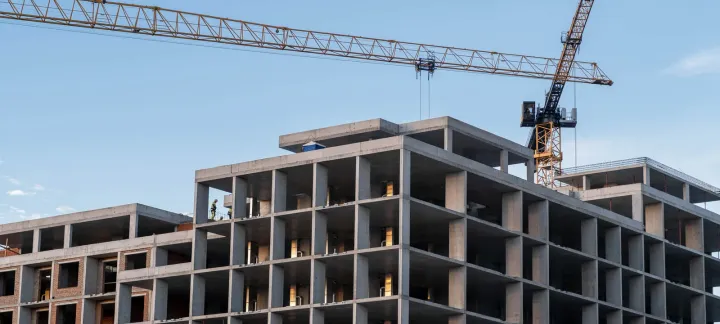
Buying off-plan can be the most sensible way to get a new home with a modern layout and better features, but it also carries specific risks: construction is not yet complete, the terms are agreed in advance, and the deadlines and quality depend on how the work is carried out. A safe deal is not a matter of luck but of consistent checks, a properly structured contract and clear rules on payment, handover and responsibilities.
The topic is directly tied to choosing new construction and the real steps before a transaction. If you are comparing projects and availability, a good starting point is the New construction and Property search sections, where you can see how the choice is structured by property type, project and parameters.
1What “buying off-plan” means and where the risks most often hide

“Off-plan” most often means buying before the building has been put into operation, and sometimes before it has reached an advanced stage (for example before or around the shell-and-core stage). The risk is not the fact that construction is in progress, but whether the following key points have been properly settled: the legal basis for the construction, clear parameters of the property, deadlines and penalties, the payment schedule, supervision of the works and guarantees.
The most common problems with off-plan purchases arise at four moments: at reservation/deposit without sufficient documents, at the preliminary contract (unclear clauses), when deadlines slip without working penalties, and at handover, when defects or discrepancies with what was promised come to light.
2How to prepare the purchase so that you stay protected
1) Define the real search parameters
Before moving on to contracts, it must be clear exactly what is being sought: type of home, minimum usable area, preferred orientation, number of floors, need for a parking space/garage, preferred location and an acceptable budget with a reserve for finishing. With new construction, one of the most important mistakes is to plan a budget only up to the notarial deed, without accounting for finishing and furnishing.
If you are comparing “turnkey” and “to BDS standard” options, it makes sense to look at the real logic of the costs, because that is exactly what affects the safety of the decision (whether there will be the resources to finish the home without compromise).
2) Check the developer and the project structure
A safe purchase begins with who is behind the project. Check previous completed projects, reputation for meeting deadlines, how finishing is organised and the response to warranty claims. It is also important to clarify who the seller under the contract is: the developer, the builder, a special-purpose company or another holder of the right to build.
This logic is also present in the guidance on buying new construction, including the emphasis on checking the developer and the payment terms.
3) Clarify the legal basis: land, right to build, building permit
Security rests on the documents that grant the right to build and describe the project. It is not enough to have “plans” and “visualisations”. What you look for is the legal framework: who owns the property/UPI plot, how the right to build was established (if applicable), whether there is a valid building permit, and whether there are encumbrances and registrations that could affect the transaction.
This part is critical because a problem here is not solved by a “good offer”. If the legal basis is unclear, the risk passes directly to the buyer.
3Full checklist before the deposit and preliminary contract

- Title deed for the land or a document establishing the right to build, and clear identification of the seller (who signs, and on what grounds)
- Building permit and a set of design documentation sufficient to identify the building, entrance, floor and the specific unit
- Sketch/plan and description of the property per the design: rooms, floor areas, orientation, terraces, ancillary parts (if any)
- A clear distinction between net area, common parts and total area, and exactly how the price is formed
- Description of the level of completion at handover: what is included (installations, screeds/plaster, windows and doors, common parts)
- Completion and handover deadline, with specific penalties for delay and a clear definition of how delay is measured
- Payment schedule by stages, tied to verifiable events/milestones and not only to dates
- Rules for design changes (if possible): deadline, cost, how they are requested, when the option ends
- Conditions for terminating the contract and refunding sums in case of material non-performance
- Bank financing: whether the project is acceptable to banks, how the mortgage is structured and what documents will be required
4The preliminary contract: what must be clear for it to be safe
The preliminary contract is the main document when buying off-plan. It should contain no “general promises”, but specific, measurable parameters. The mandatory content for safety is the identification of the property (so that there can be no substitution), price and method of payment, deadlines, penalties, degree of completion, handover rules, guarantees and responsibilities.
The riskiest are vague wordings such as “approximate deadline”, “equivalent materials”, “to the builder's standard”, with no specifications attached. If there is no clear specification, the buyer has no basis for comparing what was promised with what was received.
With listings and offers, it is important to have real and verifiable information, because problems often start with misleading descriptions.
5Payments: a safe scheme means payment against progress
When buying off-plan, payment should follow a logic: the buyer pays against measurable progress, not only against a promise. The structure depends on the project, but the principle is the same: every subsequent sum should have a basis – a stage, a document, an event that can be verified.
In new-construction practice, this is also regarded as a key part of a safe purchase – the payment terms and contractual penalties are precisely the main tool for reducing risk.

The stages matter because they determine what is actually finished and what is still to come. The buyer needs to know at what stage they are buying and how this affects deadlines, payments and the possibility of final transfer.
In new-construction offers, a status such as “pre-Act 15” is often given, which is an indication of progress and of the risk to deadlines.
The most important practical rule is this: it must be clear who bears responsibility until handover, how readiness is proven, what happens in the event of delay and how the penalty is triggered.
6Checklist for handover of the property and before the final transaction
- Handover with a handover protocol: all snags are described specifically (what, where, and by when each will be fixed)
- Check floor areas and parameters against the contract/design: rooms, terraces, ancillary areas and common areas
- Test installations and key points: plumbing (pressure/leaks), electrics (distribution board/protections), ventilation (if applicable), terrace drainage
- Windows and seals: opening/closing, levelling, condensation risks, joints
- Walls, ceilings, floor: visible defects, cracks, flatness, signs of damp
- Common areas: entrance, stairwell, lift, finishing, lighting, access
- Parking space/garage (if any): exact identification, dimensions and access, level, ease of manoeuvring
- Commissioning documents (if applicable at the time of the transaction) and readiness for transfer before a notary
- Clarity on warranties: periods, claims procedure, contact and response time
7Warranties, claims and “life after handover”
Even with quality construction, problems that are not visible at the first viewing can appear after moving in: settlement, micro-cracks, window adjustments, minor leaks, noises. A safe purchase means there is a clearly described warranty framework: how to report an issue, how quickly it is responded to and how the fix is certified.
From a practical point of view, it is important not only to have warranties “on paper” but also a working channel of communication.
8The most common “red flags” when buying off-plan
Risk signals usually appear in combination rather than as a single sign: a refusal to provide documents “before the deposit”, a contract with unclear parameters, no real penalties, payment that is not tied to stages, terms that keep changing “on the go”, a mismatch between the design and the promise, or overly aggressive advertising with no specifics.
A secure purchase does not require suspicion, but discipline: documents, transparent terms and consistent control.
Buying “off-plan” is safe when every key risk has been addressed in advance:
- legal basis,
- clear identification of the property,
- a contract with workable deadlines and penalties,
- payment by stages,
- real quality control
- and a well-organised handover with a protocol and warranties.
When these elements are in place, “off-plan” is not a compromise but a strategic choice:
- you get a new home,
- better energy efficiency,
- more modern solutions
- and the chance to plan your home according to your needs.
Comments
There are no comments yet. Be the first to share what you think about the article.